
resume-rewrite
Resume Rewrites with Gemini 3: JD Fit, ATS, and Metrics
Gemini3 Team · July 18, 2026 · 5 min read
Keywords: resume rewrite with gemini 3, ats-friendly resume generator
Published: July 18, 2026 Author: Gemini3 Team
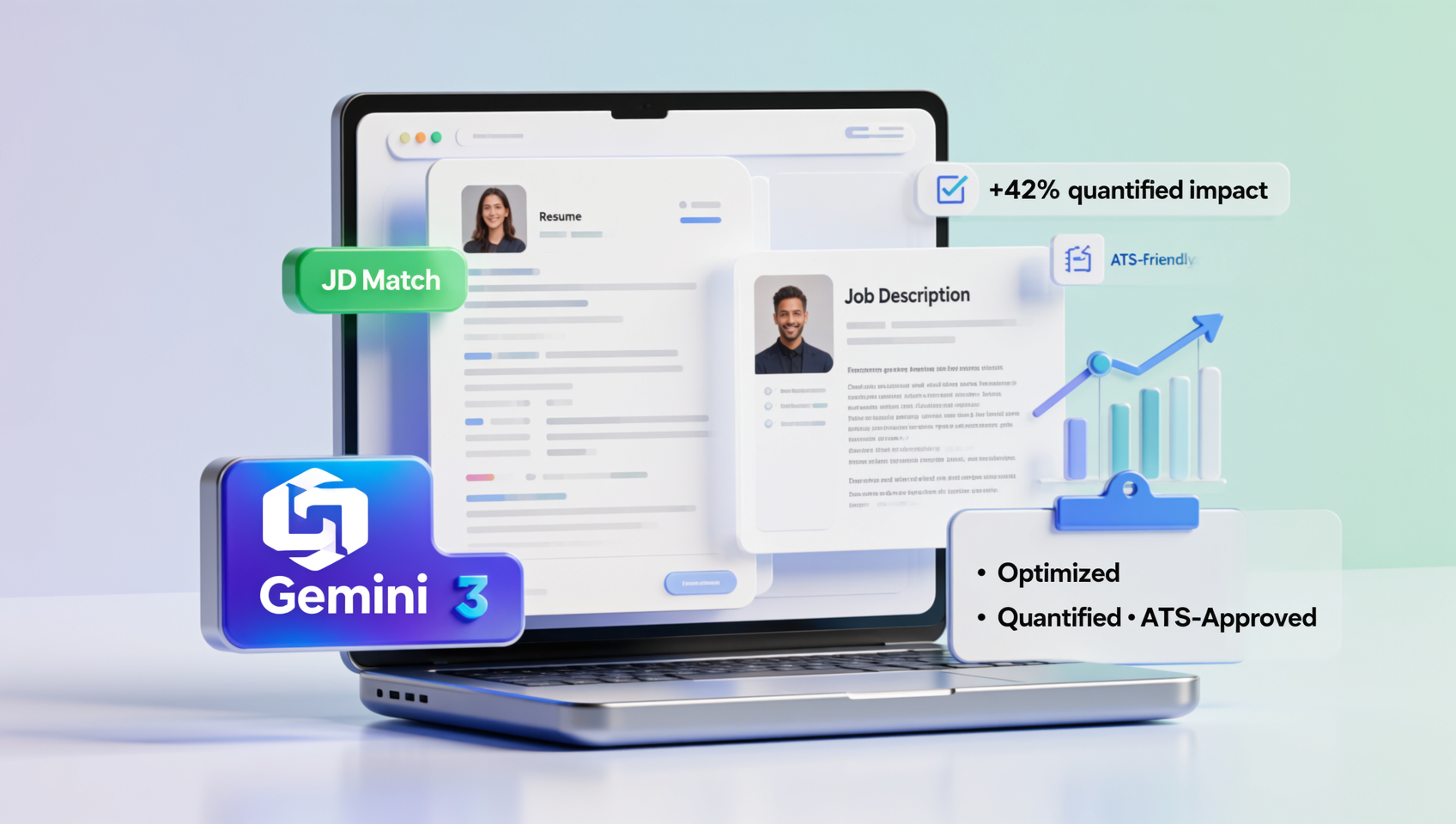
Why “Good Enough” Resumes Fail—And What Changes With Gemini 3
If you’ve applied to 50+ roles and landed zero interviews—or worse, got ghosted after a recruiter call—you’re not underqualified. You’re under-translated. Your experience isn’t being parsed correctly by either humans (hiring managers scanning in <6 seconds) or machines (ATS systems rejecting 75% of resumes before human eyes ever see them).
Gemini 3 on MidassAI Chat doesn’t just “rewrite” your resume. It treats your background as structured data, cross-references it against real-time job descriptions, identifies semantic gaps, and rebuilds bullet points using role-specific verbs, quantified outcomes, and ATS-safe phrasing—all in under 90 seconds. This isn’t templated editing. It’s precision rewriting grounded in three non-negotiable layers: JD fit scoring, ATS keyword alignment, and impact-driven rewriting.
Let’s break down how each layer works—and what to watch for.
JD Fit Analysis: Beyond Keyword Matching
Most tools scan for exact phrase matches (“Python”, “Agile”, “P&L”). Gemini 3 goes deeper: it maps intent, seniority, and domain context. For example, if a JD says “Led cross-functional product launches from ideation to GA”, Gemini 3 checks whether your original bullet says “Managed product launch”—and flags it as weak because “managed” ≠ “led”, “product launch” lacks scope (“cross-functional”, “ideation to GA”), and omits outcome. It then scores fit on a 0–100 scale per section (Summary, Experience, Skills), highlighting where language drift occurs.
Real prompt you can paste into MidassAI Chat right now:
Analyze JD fit for this job description and my resume. Score each section (Summary, Experience x3, Skills) on relevance, verb strength, and scope alignment. Flag mismatches where my wording undersells responsibility or omits implied expectations (e.g., “owned” vs “supported”). Return a table: [Section] | [Fit %] | [Key Gap] | [Rewrite Suggestion].
JD: [paste full JD]
Resume: [paste plain-text resume]
⚠️ Pitfall to avoid: Don’t feed Gemini 3 PDFs. Paste clean text only—PDF OCR errors (e.g., “expenence” instead of “experience”) derail analysis. Always verify formatting before pasting.
ATS Optimization: Not Just Keywords—Contextual Density
ATS systems don’t just count keywords. They assess contextual density: how naturally terms appear in relation to responsibilities and outcomes. A resume stuffed with “Kubernetes”, “CI/CD”, and “SRE” in a skills list—but zero evidence of using them in bullets—scores lower than one with fewer terms but clear usage: “Reduced deployment latency 40% by migrating legacy pipelines to Kubernetes-managed CI/CD (GitLab + ArgoCD)”.
Gemini 3 identifies missing semantic clusters: groups of related terms that signal domain fluency (e.g., “AWS EC2/EBS/CloudWatch” > just “AWS”). It then rewrites bullets to embed those clusters within action-outcome syntax, not as standalone phrases.
Example before → after:
❌ “Used AWS services for cloud infrastructure.”
✅ “Cut infra provisioning time 65% by automating EC2 instance scaling and EBS volume management via CloudWatch-triggered Lambda functions (AWS Certified DevOps Engineer).”
Note the shift: same tech stack, but now embedded in a measurable outcome, with toolchain specificity and credential validation—exactly what modern ATS engines weight most heavily.
Rewriting Experience: Verbs, Metrics, and Role-Specific Framing
Strong verbs matter—but only when paired with role-aligned metrics. “Spearheaded” means little for a UX researcher; “Validated 12+ user journey hypotheses via moderated remote testing (n=42), increasing task success rate 28%” does. Gemini 3 adjusts verb choice and metric framing based on function:
- Engineering: Focus on scale (“served 2M+ users”), latency (“reduced API response time from 1.4s → 280ms”), and ownership (“owned end-to-end migration of monolith to microservices”).
- Marketing: Prioritize conversion lift (“increased CTR 3.2x via A/B-tested ad creatives”), pipeline impact (“generated $1.8M SQLs at 14% close rate”), and channel efficiency (“drove 62% of qualified leads via organic SEO”).
- Operations: Highlight process velocity (“cut onboarding cycle from 14 → 3.5 days”), cost avoidance (“prevented $220K/yr in compliance penalties via audit-ready SOPs”), and stakeholder scope (“scaled vendor onboarding for 47 global partners”).
Gemini 3 won’t invent numbers—but it will prompt you: “What was the baseline? What was the delta? How many people/systems were involved?” If you answer those, it builds bullet points that pass both algorithmic and human scrutiny.
Who This Is For (And Who It’s Not)
This workflow is built for professionals who:
- Have 3+ years of experience and concrete deliverables (not entry-level candidates still building portfolios),
- Apply to roles where JD language is precise and technical (tech, finance, healthcare ops—not generic “admin” listings),
- Are willing to spend 5 minutes refining inputs (pasting clean text, answering follow-up metric questions), and
- Treat resume iteration as ongoing—not a one-time “set and forget” task.
It’s not for those expecting magic: Gemini 3 can’t fabricate promotions, certifications, or projects you didn’t do. It amplifies truth—not fiction. And it won’t replace strategic job targeting; it makes your existing profile visible where it already fits.
Quick Takeaways
Try It—Then Iterate
The fastest way to test this isn’t with your final resume. Start with one past application where you got no response. Paste the rejected resume + that JD into MidassAI Chat. Run the JD fit analysis. Then use Gemini 3’s rewrite suggestions—not as final output, but as a diagnostic lens. Ask: Where did my original language fail to mirror the employer’s mental model?
You’ll spot patterns fast: overuse of passive verbs, vague scope (“helped with…”), missing stakeholder counts, or buried metrics (“improved performance” vs. “cut batch job runtime from 42 → 9 min”). That awareness alone cuts future rewrite time by 70%.
No more guessing why applications stall. No more keyword stuffing. Just targeted, evidence-based translation—powered by Gemini 3’s ability to read between the lines of both your background and the hiring team’s unspoken priorities.
Try Gemini 3 on MidassAI Chat and run your first JD fit analysis in under a minute.